Blog
Weight Distribution: Where To Position Your Vehicle On The Deck

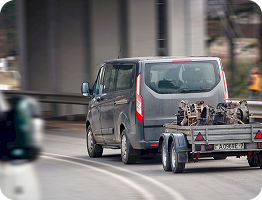
The difference between a smooth tow and a white-knuckle disaster often comes down to inches. Move a car six inches forward or backward on the trailer deck, and the entire handling character changes. Understanding why this happens transforms you from a casual renter into someone who tows with confidence and control.
The Physics Of Towing
Every trailer follows the same physical laws. The tongue, the part that attaches to your hitch, must carry between ten and fifteen percent of the total loaded weight. For a 5,000-pound car-and-trailer combination, the tongue needs to support 500 to 750 pounds.
This weight presses down on your hitch ball and transfers force to your tow vehicle's rear axle. It creates friction between your tires and the road. It keeps the trailer from swinging side to side like a pendulum.
Drop below that ten percent threshold, and the trailer becomes unstable. Exceeding fifteen percent, and you overwhelm your hitch and overload your tow vehicle's suspension.
What Happens With Too Little Tongue Weight
Imagine pushing a shopping cart with an empty basket versus one loaded with cases of water. The empty cart wanders. It darts left and right with every imperfection in the pavement. You fight it constantly.
A trailer with insufficient tongue weight behaves exactly the same way. The rear of the tow vehicle feels light. Passing trucks create blast waves that push the trailer to the side. Sway begins gradually, then compounds rapidly. By the time you feel the oscillation, recovery requires skill and luck in equal measure.
Drivers who position vehicles too far back on the deck experience this scenario. The car's weight centers behind the trailer axles, lifting the hitch rather than pressing it down. The trailer essentially tries to pass the tow vehicle rather than follow it.
What Happens With Too Much Tongue Weight
Excess tongue weight creates a different set of problems. The tow vehicle's rear suspension compresses. Headlights point skyward. Steering loses precision because the front wheels carry insufficient weight for proper traction.
Braking distance extends. The trailer now pushes the tow vehicle rather than responding to it. On downhill grades, this forward weight bias overwhelms the tow vehicle's brakes. Jackknife potential increases.
Drivers who position vehicles too far forward create this condition. The car's weight is concentrated on the hitch rather than being distributed evenly across the trailer.
The Correct Position For Most Vehicles
For standard passenger cars, sedans, and SUVs loaded onto an 18-foot car hauler, position the vehicle so its rear axle sits slightly ahead of the trailer's axle centerline. This places approximately 60% of the vehicle's weight forward of the trailer axles and 40% behind them.
Walk around the combination after positioning. The trailer should sit level from front to back. If the coupler end points downward or the rear end drags low, adjust accordingly.
Most rental customers can achieve a correct balance by positioning the vehicle so the trailer tongue weight feels substantial but not excessive when you attempt to lift it by hand. A properly loaded trailer resists lifting but does not require heroic effort.
Special Considerations For Different Vehicles
Front-heavy trucks and vans require different positioning. A diesel pickup with a heavy engine places more than sixty percent of its weight over the front axle. To achieve proper tongue weight, these vehicles must sit farther forward on the deck than a standard sedan.
Sports cars with low ground clearance demand attention to approach angles. The dovetail design on certain trailers helps prevent scraping, but positioning still matters. Load these vehicles carefully, watching the front fascia as you winch or drive up the ramps.
Rear-engine vehicles like older Porsches or Corvairs invert the normal weight distribution. Their heaviest point sits behind the driver. These require rear bias positioning to maintain proper tongue weight.
How To Verify Before Driving
Take five minutes after loading to confirm your setup. Drive to an empty parking lot. Make gradual left and right turns at low speed. The trailer should follow the tow vehicle's path without wandering too far or cutting the corner too short.
Brake gently from twenty-five miles per hour. The combination should stop in a straight line. If the trailer pushes or the tow vehicle struggles, adjust positioning.
Check all straps after your test drive. Proper tension matters. Straps should be tight enough that the vehicle suspension compresses slightly, but not so tight that you damage components.
What To Avoid
Never trust the vehicle's parking brake alone during loading. Chock wheels before unhitching. Never load a vehicle so that the trailer tilts significantly forward or rearward. Never assume positioning is correct without verifying tongue weight.
The most experienced tower operators check their setup every time. Complacency causes more accidents than mechanical failure.
Final Consideration
Our trailers feature open deck designs that allow flexible positioning. Take advantage of this adjustability. Move the vehicle until the combination feels stable. Your safety depends on getting it right.
Questions about your specific vehicle and trailer combination? Speak with our rental team before loading. We can help you understand what proper positioning looks like for your situation.